Engineering Economics
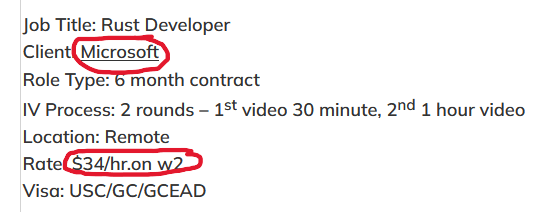
I got a recruiter email this week that made me smile, not because it was “great,” but because it felt like a signal flare from reality:
Job Title: Rust Developer
Client: Microsoft
Role Type: 6 month contract
Location: Remote
Rate: $34/hr on W2
Interview: 2 video rounds
Let’s translate that rate. $34/hr on W2 is roughly $70K/year if it were steady 40-hour weeks year-round. And contracts rarely behave like a clean salary: gaps happen, benefits are different, the risk sits with you.
A few years ago, in certain pockets of the market, $200K, $500K, $700K+ total comp became common enough that we started treating it as the natural order of things.
It wasn’t. It was a moment: cheap capital, hypergrowth, and a belief that every company was becoming a software company overnight.
AI is snapping us back to something closer to the 90s: engineering as a great career, not an aristocracy.
In other words: we’re moving from “engineers as financial outliers” back to “engineers as well-paid professionals.”
This shift is rough in the short term, especially for people who planned their lives around peak-comp norms. But zoom out and it makes sense. In the 90s (and in most of history), the big premiums belonged to medicine and law: long training pipelines, licensure, high liability, direct ties to courts and life outcomes. Engineering was respected and stable, but it wasn’t the cultural and compensation apex.
AI is doing two things at once:
1. Lowering the cost of producing software (more leverage per person)
2. Raising the bar on what “engineering” actually means (taste, systems thinking, reliability, product judgment)
When building gets easier, routine implementation becomes cheaper. That’s not a tragedy. That’s the point of better tools.
The optimistic take: AI is unbundling engineering into layers:
* commodity work priced like commodity work
* high-agency, high-liability, high-ownership work rewarded accordingly
and other professions (medicine, law) are returning to their historically outsized premiums because their moats aren’t “syntax,” they’re accountability
Hot take: AI doesn’t “kill engineering.” It normalizes it.
So I’m curious: is this a healthy reset to 90s economics, or a race to the bottom disguised as efficiency?
Comment with one word: RESET or RACE.
 Shane Elizabeth McCrary Miller