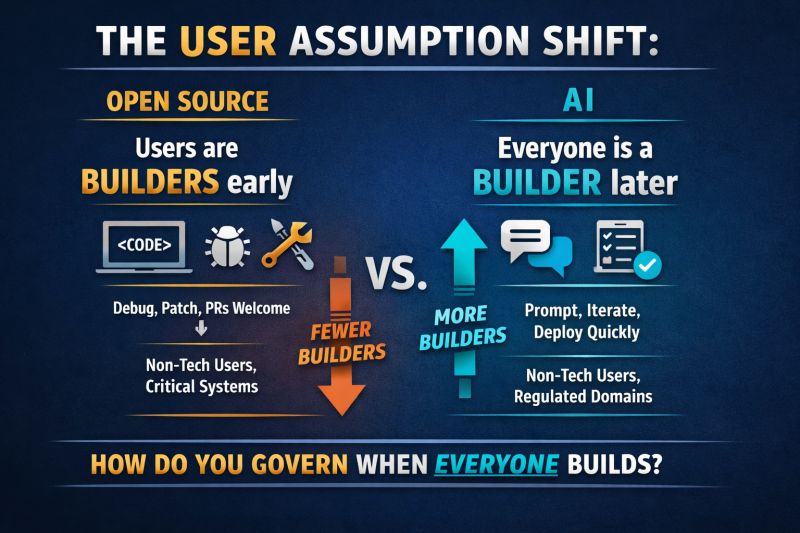
Users are Builders?
Hot take: Open source’s wins and its burnout cycles have been driven by one hidden assumption:
“Users are builders.”
In a project’s infancy, it’s true. Early adopters are engineers. They can debug, patch, and carry the maintenance load alongside the core team.
But when a project matures, the user base changes.
Now the “user” is also:
* a security org doing risk reviews
* a platform team accountable for uptime
* a hospital IT group managing change control
* a clinician or operations leader who needs outcomes, not a Git repo
At that stage, “PRs welcome” stops being community magic and starts looking like an operating model mismatch. The builder-to-user ratio collapses, while reliability, compliance, and support expectations spike.
AI flips the dynamic.
With mature AI platforms, “building” is increasingly specifying and iterating: plain-language requirements, fast prototypes, tight feedback loops. That means a far larger share of users become builders, even outside engineering, because the interface is intent, not syntax.
For leaders, that’s not a novelty. It’s a lifecycle shift:
OSS: builder-heavy early, builder-scarce late
AI: builder-scarce early, builder-heavy late (once platforms harden)
The real question: how do we design governance, safety, and accountability when “everyone can build”… especially in regulated environments like healthcare?
Where have you seen this assumption break, or this flip begin, in your org?
 Shane Elizabeth McCrary Miller